Why You Can't Let Go (And Why It's Not About Them)

You know the relationship wasn't healthy.
You know it ended for a reason.
You know your friends are tired of hearing about it.
You know you deserve better.
So why can't you let go?
Why are you still thinking about them?
Why do you still miss them?
Why do you keep replaying conversations, checking their social media, or wondering what they're doing?
Most people assume the answer is simple:
"Because I loved them."
But often, that's not the whole story.
Sometimes the hardest part of moving on isn't losing the person.
It's losing what the relationship represented.
The Truth Most People Don't Want to Hear
The reason you can't let go may have very little to do with them.
And a lot to do with what the relationship meant to you.
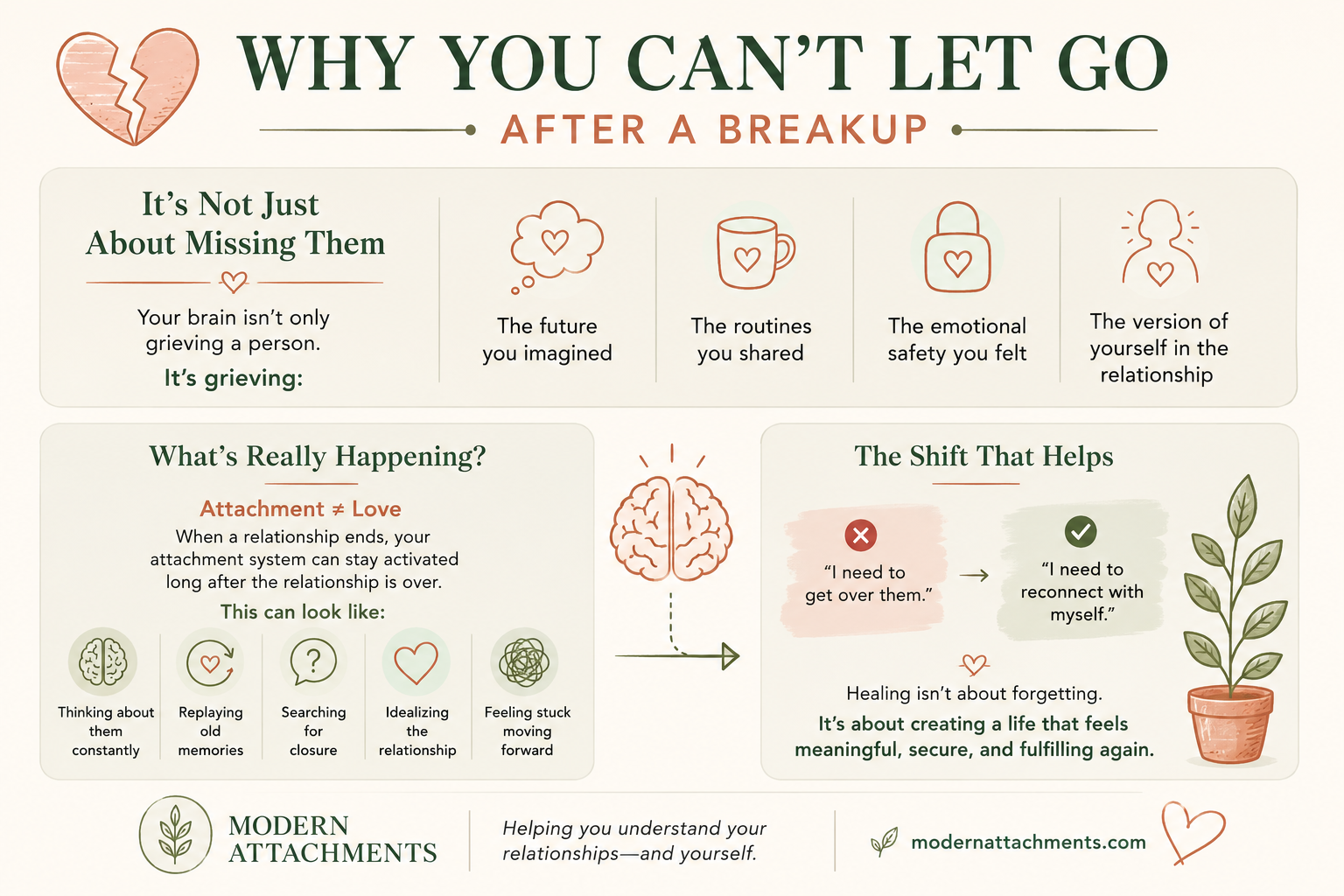
Because when a relationship ends, you rarely lose just a person.
You lose:
The future you imagined
The version of yourself you were becoming
The routines you built together
The sense of certainty
The hope that this would finally work
That's why breakups can feel so devastating.
You're grieving more than a relationship.
You're grieving a story.
Many people discover that healing isn't just about getting over someone - it's about understanding the attachment patterns and relationship dynamics underneath the heartbreak.
Why Your Brain Keeps Going Back
Many people believe that if a relationship was unhealthy, they should be able to move on quickly.
Unfortunately, that's not how the brain works.
The brain doesn't automatically let go of something just because it was bad for you.
It lets go when it feels safe enough to do so.
That's why people often find themselves:
Romanticizing the good moments
Forgetting the painful parts
Replaying memories repeatedly
Imagining different outcomes
Feeling pulled back toward someone they know isn't right for them
The brain is searching for resolution.
Not necessarily truth.
Understanding your attachment style can provide valuable insight into why certain breakups feel especially difficult to move on from.
If you've ever wondered why heartbreak can feel almost addictive, learn more about what happens in your brain after a breakup.
You May Be Attached to the Potential
One of the most painful forms of heartbreak is grieving someone's potential.
Not who they were.
Who you hoped they would become.
You may find yourself thinking:
"If only they had worked on themselves."
"If only they had been ready."
"If only things had happened differently."
But relationships are built on reality.
Not potential.
And potential can keep people emotionally stuck for years.
Because potential never disappoints you.
Reality does.
This is one of the most common relationship patterns that keeps people emotionally stuck.
Sometimes You're Actually Grieving Rejection
Many people believe they're devastated because they lost the relationship.
In reality, they're devastated because they weren't chosen.
There's a difference.
When someone leaves, rejects, or pulls away, it can activate deeper fears:
I'm not enough.
I'm unlovable.
I'll always end up alone.
Something must be wrong with me.
The breakup becomes attached to your self-worth.
And that's when healing gets complicated.
Because now you're not just grieving the relationship.
You're questioning yourself.
The Relationship May Have Been Meeting a Need
This is where things get uncomfortable.
Sometimes we struggle to let go because the relationship was meeting a need we haven't learned to meet ourselves.
Maybe it provided:
Validation
Security
Belonging
Hope
Distraction
Excitement
When the relationship ends, that need doesn't disappear.
It simply becomes visible.
And until we address the need itself, we often remain attached to the relationship.
This is one reason people can find themselves repeating similar relationship experiences over and over again.
Sometimes identifying these patterns on your own can be difficult because we're often too close to the situation. Working with a relationship coach or therapist can help uncover the deeper dynamics keeping you stuck.
Learn more about breakup coaching or take the attachment styles quiz.