5 Tools That Help You Feel Secure Before You Overthink

Because analyzing every text message isn't actually a self-care strategy.
If you have an anxious attachment style, you've probably spent hours trying to figure out what someone meant by:
"Sounds good."
"I'll let you know."
"Sorry, I've been busy."
A text that suddenly feels shorter than usual.
You tell yourself you're just being thoughtful.
But beneath the overthinking is often something deeper:
A nervous system searching for reassurance.
The good news? Healing anxious attachment isn't about becoming less caring, less emotional, or less invested in relationships.
It's about learning how to feel safe without constantly needing proof that you're safe.
If you're not sure whether you have anxious attachment, start with the Attachment Style Quiz.
Here are five tools I teach clients to help them feel secure before they spiral.
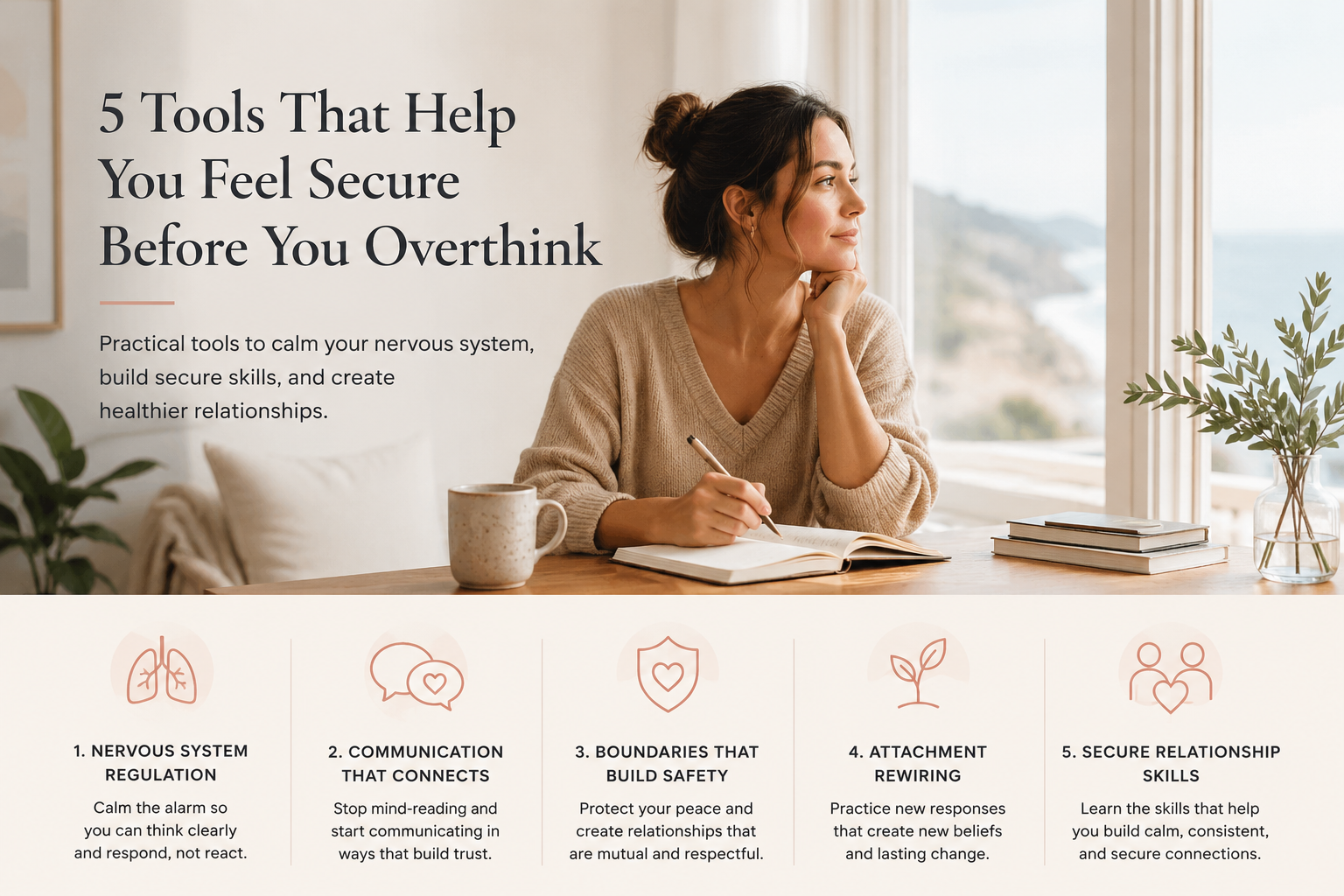
1. Nervous System Regulation
Before you solve the problem, calm the alarm.
One of the biggest misconceptions about anxious attachment is that it's a thinking problem.
Most of the time, it's actually a nervous system problem.
When your attachment system is activated, your brain starts searching for danger:
They haven't texted back.
They seem distant.
Something feels off.
The more activated you become, the harder it is to think clearly.
Instead of trying to think your way out of anxiety, start by regulating your body.
Try:
A 10-minute walk without your phone
Slow breathing with a longer exhale
Stretching or movement
Holding something warm
Naming five things you can see, hear, and feel
A regulated nervous system sees reality more clearly.
2. Communication That Connects
Stop mind-reading. Start communicating.
Anxious attachment often turns people into relationship detectives.
You analyze.
Interpret.
Decode.
Replay conversations.
Search for clues.
The problem?
Most of the time, you're filling in missing information with fear.
Secure relationships aren't built through mind-reading.
They're built through communication.
Instead of:
"They're pulling away."
Try:
"I've noticed we're talking less this week. How are you feeling about things?"
Instead of seeking certainty through analysis, seek clarity through conversation.
3. Boundaries That Build Safety
Boundaries aren't walls. They're relationship filters.
Many people with anxious attachment believe closeness comes from giving more.
More understanding.
More patience.
More availability.
More chances.
But secure relationships aren't created through self-abandonment.
They're created through mutual investment.
Healthy boundaries help you answer an important question:
Is this relationship actually meeting my needs?
Examples:
Not chasing inconsistent communication
Expressing expectations directly
Saying no without overexplaining
Allowing people to show you who they are
Boundaries don't push healthy people away.
They help reveal who's capable of meeting you where you are.
4. Attachment Rewiring
Awareness isn't enough.
Many people understand exactly why they have anxious attachment.
They've read the books.
Taken the quizzes.
Listened to the podcasts.
Yet they still find themselves repeating the same patterns.
That's because insight alone doesn't create change.
Healing happens when you repeatedly practice new responses.
Instead of:
Seeking reassurance
Over-functioning
Chasing unavailable people
Ignoring red flags
You begin practicing:
Self-trust
Emotional regulation
Healthy pacing
Secure communication
New patterns create new experiences.
New experiences create new beliefs.
Many people know their attachment style but still struggle to change the pattern. That's where Attachment Style Coachingcan help.
5. Secure Relationship Skills
Security is a skill, not a personality trait.
Many people assume secure attachment is something you're either born with or not.
In reality, secure behaviors can be learned.
Some examples include:
Tolerating uncertainty
Asking directly for what you need
Managing conflict without panic
Trusting actions over assumptions
Choosing consistency over chemistry alone
The goal isn't perfection.
The goal is becoming someone who can stay connected to both yourself and another person at the same time.
The Good News
If you struggle with anxious attachment, you're not broken.
Your nervous system learned ways to protect you when connection felt uncertain.
Those strategies made sense at one point.
But they don't have to define your future relationships.
Attachment patterns are learned.
And learned patterns can change.
With awareness, practice, and support, you can build the kind of relationships that feel calm, secure, and emotionally safe.
Not because you found the perfect person.
Because you learned how to relate differently.
If you'd like support learning how to become more securely attached, explore Anxious Attachment Coaching.
Ready to Break the Pattern?
Attachment style coaching helps you understand the patterns driving your relationships and develop the tools needed to create healthier, more secure connections.
You don't have to keep repeating the same cycle.